Welcome to Germany’s First National Park
Stretching along the Bavarian-Czech border, between Bayerisch Eisenstein in the Regen district and Mauth in the Freyung-Grafenau district lies the Bavarian Forest National Park. On October 7, 1970, this protected area was opened as Germany’s first national park. Together with the neighboring Šumava National Park in the Czech Republic, it forms the largest contiguous forest conservation area in Central Europe. On more than 24,000 hectares, the guiding principle in the Bavarian Forest is "Let nature be nature."
According to this philosophy, the forests, with their moors, mountain streams, and summit landscapes, are allowed to develop according to their own natural laws into a boundless forest wilderness. This transforms yesterday’s managed forest into tomorrow’s primeval forest. A unique biodiversity is the result. Rare animals such as the lynx, otter, capercaillie, and hawk owl find a home again. In addition, there are 15 beetle species alone, which are considered primeval forest relics and only occur in extremely nature-near forests. The particularly strong biodiversity is based, among other things, on the high proportion of standing deadwood, which provides food and habitat for hundreds of insects, fungi, and birds. Natural processes of creation and decay within the forest ecosystem are permitted in the national park, allowing dead or wind-fallen trees to remain in their natural environment.
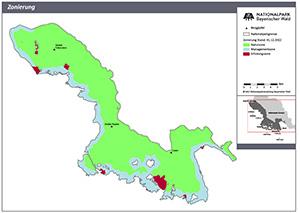
Areas where no further human intervention takes place are known as nature zones. Currently, almost 70 percent of the area in the Bavarian Forest National Park belongs to these nature zones. The aim is to increase this proportion to 75 percent by 2027.
Typical habitats in the Bavarian Forest National Park include three natural forest communities, for whose formation the large differences in altitude and the harsh, rainy climate with snowy winters are responsible: high-altitude spruce forests in the higher elevations above approximately 1200 meters, mixed mountain forests with spruce, fir, beech, and mountain maple in the warmer, slope-facing areas, and flood-plain spruce forests in the wet valley bottoms with nocturnal cold air pooling. In addition, the national park also contains moorland and once-cultivated high pastures, known as Schachten in the Bavarian Forest.
The National Park Centers at Lusen near Neuschönau and Falkenstein near Ludwigsthal offer all visitors an exciting introduction to the protected area. At both locations, an information building invites you to explore. Each National Park Center also has an animal enclosure, which provides an insight into the original fauna of the Bavarian Forest. In addition, the Forest History Museum in St. Oswald offers an interesting insight into the history of the national park. The facilities can be experienced with all the senses, at any age and in any season. Barrier-free paths with gentle gradients make it easier for people with disabilities and families with strollers to enjoy the nearby natural beauty.
Thanks to around 350 kilometers of marked hiking trails, over 200 kilometers of signposted cycle paths, and approximately 80 kilometers of groomed trails, the national park is wonderfully accessible to nature lovers. In addition, the year-round guided tour program enables exciting national park experiences with expert guidance. Trained forest guides and national park experts provide insights into the nature of the protected area. Separate programs for children, illustrative lectures, and cultural events in the national park facilities round off the offering. (Extracted from https://www.nationalpark-bayerischer-wald.bayern.de/ueber_uns/steckbrief/index.htm)
You will find further information, in particular behavior tips and the current program of the national park, at: